
County of Fortune Social Classes: Peasants to Patricians
Quick answer
County of Fortune has four social classes — Peasants (settlement level 1), Commoners (level 2), Artisans (level 3) and Patricians (level 4) — and each one unlocks when a settlement's Food and Equipment needs are fully supplied and you click Level Up. The demo caps you at level 2 and Commoners; the Early Access version removes that cap and adds the two higher classes. That cap and the two new classes are confirmed in the game's DEMO FAQS on Steam, checked on 2026-11-02.
| Demo class cap | The demo caps settlements at level 2 and the Commoner classCounty of Fortune DEMO FAQS on Steam |
|---|---|
| Early Access class cap | Early Access raises the settlement cap to level 4 and adds Artisans and PatriciansCounty of Fortune DEMO FAQS on Steam |
| Level up control | Click the Level Up button on the settlement screen, just left of the mayor's portraitCounty of Fortune DEMO FAQS on Steam |
| Peasant equipment | Peasant-tier equipment is wooden chests or wool tunics, and supplying it unlocks the next building slotCounty of Fortune DEMO FAQS on Steam |
County of Fortune social classes explained: how each settlement tier works, what needs unlock Commoners, Artisans and Patricians, and how to level up.
Table of Contents
County of Fortune has four social classes — Peasants (settlement level 1), Commoners (level 2), Artisans (level 3) and Patricians (level 4) — and each one unlocks when a settlement's Food and Equipment needs are fully supplied and you click Level Up. The demo caps you at level 2 and Commoners; the Early Access version removes that cap and adds the two higher classes. That cap and the two new classes are confirmed in the game's DEMO FAQS on Steam, checked on 2026-11-02.
The four classes at a glance
| Class | Settlement level | Core needs | What it brings |
|---|---|---|---|
| Peasants | Hamlet (1) | Basic food, basic equipment (wooden chests or wool tunics) | Farms, extraction, carpenter's guild |
| Commoners | Village (2) | Varied foods, improved equipment | Small market, raft port, tavern, mills and bakeries, cheese production, stonework buildings |
| Artisans | Town (3) | Composite dishes, advanced equipment | Foundry, glassworks, higher workshops |
| Patricians | City (4) | Luxury items, refined food and clothing | Top-end luxury manufacturing and the biggest populations |
The Peasant and Commoner rows are confirmed by the official demo FAQs. The Artisan and Patrician rows come from player-collected notes on the community wiki and first-hand Early Access footage, so treat the exact building lists as indicative rather than final. According to players who compiled that wiki, Patricians are expected to want luxuries such as painted cabinets, medicine, instruments, glass tableware and fine clothing. The demo never reaches that tier, so the list is not a complete recipe.
How a settlement levels up
Levelling is never automatic. Fulfilling needs unlocks the button; you still have to press it.
Open the settlement panel and read the Needs tab
The Needs tab is the source of truth. It lists every Food and Equipment requirement for the settlement's current class and shows whether each good is actually being consumed.
Supply every need in both categories
Food alone is not enough. A missing equipment good — or any red icon in the Needs tab — blocks the upgrade even when the granaries are full. Community guides report that several food types together raise satisfaction, and that processed goods like bread and cheese carry the upper tiers.
Check the goods are arriving
Confirm deliveries actually reach the settlement by road or river. Production somewhere in the region does not count if the carts cannot get there.
Click Level Up next to the mayor portrait
The button sits on the settlement screen, just to the left of the mayor's portrait. After the upgrade, the new class's building tab and needs appear.
Recheck needs before touching the next settlement
The new class adds new requirements. Add production for them before levelling a second settlement, or both towns will compete for the same scarce goods.
Why equipment matters so much
Equipment does double duty. Supplying it opens the next building slot for a settlement's class, and from level 2 upward it also raises the maximum number of workers in those buildings. That makes equipment both a gate and a throughput upgrade.
The cycle runs like this: more equipment unlocks more slots and workers, those workers produce more, and the surplus funds still more equipment. A weak equipment chain chokes the whole cycle, which is why wooden chests or wool tunics deserve early priority.
Level down as a deliberate tool
You can also demote a settlement, and often you should. When two towns are pulling on the same limited goods, pick the one whose upgrade is worth the most, funnel the supply there, strip the redundant needs from the other, and rotate levels that way instead of watching an entire region go hungry. The developers mention this demotion option in the demo FAQs, and players running level 3 economies use the same rotation trick.
Reaching Artisans and Patricians
The two upper tiers are Early Access content, and they change how you plan. Artisan dishes are composite foods that combine several production chains — beef with chestnut oil, bread, flour and grain is one example players have built. Build the raw and processed inputs before you upgrade, because a Town with no bakery and no oil press produces nothing useful.
One player's recorded Early Access session shows the pattern well: eggs and seladonite go to a paint workshop, paint and planks feed a painted cabinet workshop, and glassworks supply lamps and glass tableware — with trade routes moving each intermediate good between specialized settlements instead of every town making everything.
Players who maintain the community wiki advise holding the luxury chains back until your economy is solid, because those goods involve long, costly production lines that lean heavily on trade. Pushing every settlement to the top is unnecessary — a farm town can happily sit at tier 2 while a workshop hub chases level 4.
Troubleshooting a stuck settlement
- Food is supplied but the button stays locked. Check Equipment too. Every consumption need must be met, not one category.
- A red icon in the Needs tab. That good is not being consumed. Trace the road or river route and confirm a connected trade route actually carries it.
- Production buildings show a warning icon. The building is missing an input product — a quality-of-life feature the developers added so shortages are visible at a glance.
- The site itself may be the limit. Community wiki editors say a settlement's maximum level is bounded by its buildable area, so a cramped site can cap below level 4 even with perfect supply.
Next steps
- Read the County of Fortune construction points guide if masonry requirements start blocking Commoner buildings at level 2.
- Use the County of Fortune production chains guide to plan the multi-chain composite foods Artisans demand before you spend the upgrade.
- Check the County of Fortune mayors guide: the Level Up button sits next to the mayor's portrait, and mayor bonuses affect how well the new buildings perform.
FAQ
What are the County of Fortune social classes?
There are four: Peasants, Commoners, Artisans and Patricians. Every settlement begins with Peasants at level 1. Reaching level 2 brings Commoners, while levels 3 and 4 — Artisans and Patricians — exist only in Early Access, since the demo ends its progression at Commoner.
How do I unlock Commoners?
Fulfill every food and equipment need for a settlement, then click the Level Up button left of the mayor's portrait. Once it reaches level 2, the Commoner building tab and its needs appear in the settlement panel.
My food is covered, so why won't the settlement promote?
Equipment is the usual culprit. A settlement needs all consumption needs met in both the Food and Equipment categories — a missing chest, tunic or other good leaves a red icon in the Needs tab and blocks the upgrade.
Do Patricians need luxury goods?
Yes. According to the players who compiled the community wiki, the top tier is expected to demand painted cabinets, medicine, musical instruments, glass tableware and fine clothing. The demo never reaches that tier, so treat the list as indicative and confirm against the Needs tab when you get there.
Page checked 2026-11-02 against the official County of Fortune Steam page, the developer's DEMO FAQS and community hub on Steam, a first-hand Early Access supply-chain video, and player-collected notes on the community wiki. Building lists for Artisans and Patricians, the Patrician luxury goods list and the buildable-area level cap remain community reports, not developer-confirmed details.
Related guides for this game
County of Fortune Guides
County of Fortune Alburn Food Needs: Beans, Buckwheat, Oats
County of Fortune Alburn food needs are beans, buckwheat and oats in the early-access playthrough; check the Needs tab to confirm the exact goods to ship.
County of Fortune Alburn iron mine and Foundry Guide
Build a County of Fortune Alburn iron mine, link roads, appoint a mayor, and ship ore into a level 2 foundry to smelt metal bars for downstream workshops.
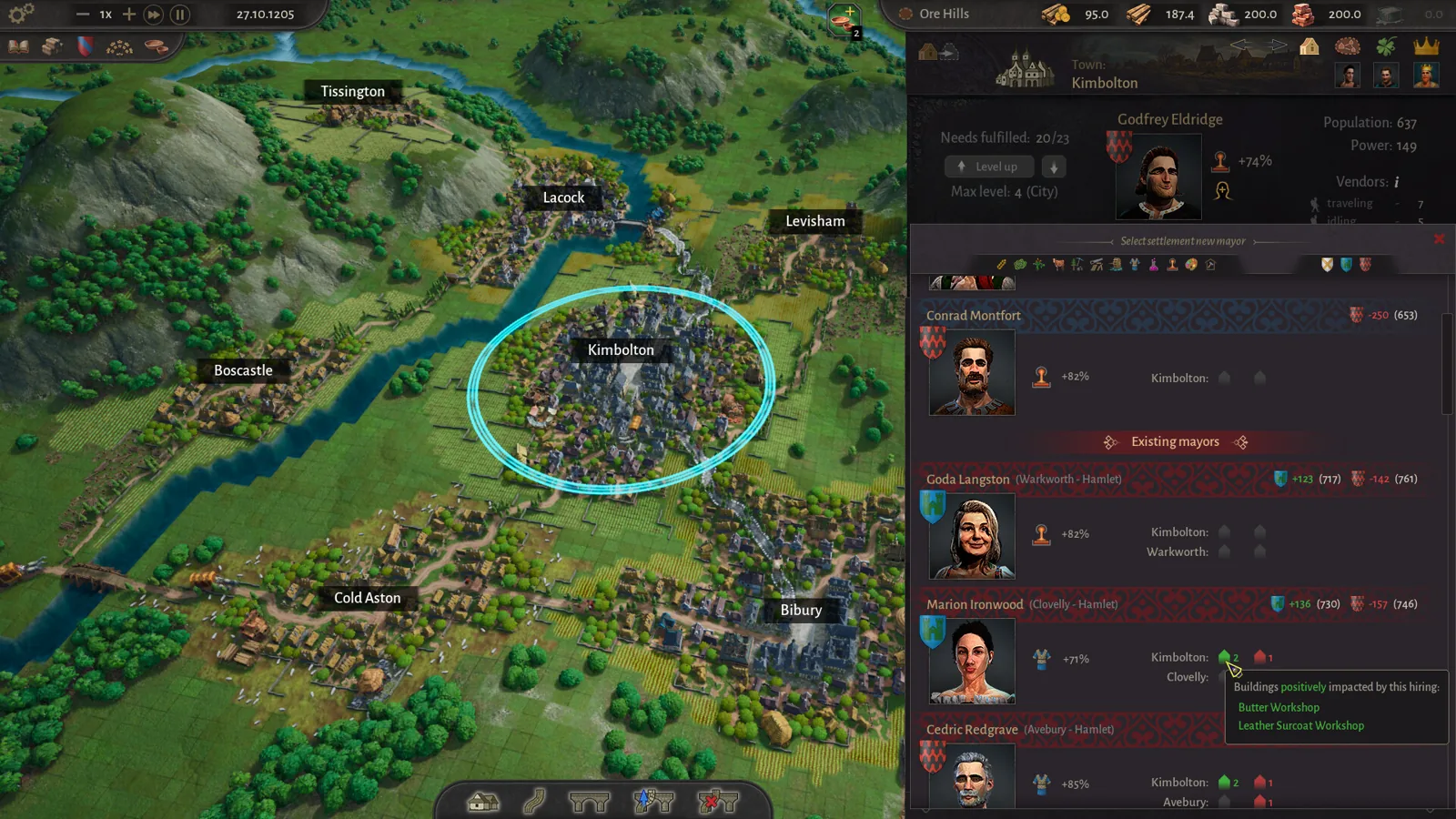
County of Fortune Assembly Votes and Privileges Guide
Learn how the County of Fortune assembly works, from house proposals and steward votes to regional privilege effects, corruption risks and eligibility.
County of Fortune Build the Chandlery: Mason’s Guild Guide
County of Fortune build the chandlery explained: raise a mason's guild for masonry points, supply an apiary, and fix the 0% production worker shortage.
County of Fortune Mechanics

County of Fortune Multiplayer: Is Co-op Available?
County of Fortune multiplayer status confirmed: the Steam page lists only single-player, so here is exactly what that means for co-op and shared counties.
County of Fortune Platforms
County of Fortune mac support: Steam platforms listed
County of Fortune mac support is not listed on Steam as of 2026-11-02: the page shows Windows and SteamOS + Linux only, with no macOS install announced.