
County of Fortune Assembly Votes and Privileges Guide
Quick answer
In the County of Fortune assembly, each noble house proposes a regional privilege, every regional steward votes for one proposal, a winning proposal emerges, and you grant it to one eligible region whose steward backed it. Community demo reports say the option gathering the most support wins, and the Assembly panel tracks available gatherings, the proposals on the table, their effects and which stewards back each one. The practical answer is to pick the recipient region first, then choose the proposal whose likely voters make that region eligible.
| Voting flow | Each noble house proposes a regional privilege, each regional steward votes for one proposal, and the player chooses an eligible recipient region.Steam Community :: County of Fortune |
|---|---|
| Feature status | The Assembly was added to the public demo as a new noble-house relationship feature.Steam Community :: County of Fortune |
| Official examples | The developer announcement names increased regional-capital efficiency and additional traders as possible privileges.Steam Community :: County of Fortune |
| Update 0.1.10 | The demo patch fixed corruption privilege value computation with mayor traits and a crash when removing a privilege.Steam Community :: County of Fortune |
Learn how the County of Fortune assembly works, from house proposals and steward votes to regional privilege effects, corruption risks and eligibility.
Table of Contents
In the County of Fortune assembly, each noble house proposes a regional privilege, every regional steward votes for one proposal, a winning proposal emerges, and you grant it to one eligible region whose steward backed it. Community demo reports say the option gathering the most support wins, and the Assembly panel tracks available gatherings, the proposals on the table, their effects and which stewards back each one. The practical answer is to pick the recipient region first, then choose the proposal whose likely voters make that region eligible.
The developer described the same basic flow in the official Steam community announcements: stewards from all regions gather, houses put forward regional privileges such as more efficient capital buildings or additional traders, and each steward supports one proposal.
How a proposal becomes a regional privilege
| Stage | What happens | Why it matters |
|---|---|---|
| Proposal | Every noble house puts forward one regional privilege, usually reflecting its own interests. | Compare the modifier with each region’s economic role. |
| Steward vote | Each regional steward supports one proposal. Community reports say influence, relations and the proposal itself affect support. | The sponsoring house is not the only factor in a vote. |
| Winning proposal | Community demo reports say whichever option attracts the most votes is adopted. | Backing a weaker but eligible option may be better than chasing the largest bonus. |
| Grant | You choose one region whose steward supported the winning proposal. | A region is not eligible when its steward voted against the winner. |
The important limitation is eligibility. A positive privilege can win the vote yet still be unusable in the region you wanted if that region’s steward supported a different proposal. Check steward alignment before spending an available assembly, not afterward.

Assembly workflow
Community demo reports describe an Assembly panel with an available-assembly count and a Convene assembly control. The developer has not published a fixed recharge interval.
Choose the intended recipient
Decide which region needs help before looking at the winning side. A developed capital, a self-sufficient region and a region with strong mayors benefit from different privileges.
Open the Assembly panel
Review the available gatherings, current privilege proposals, reported effects and stewards associated with each option. Do not convene simply because an assembly is available.
Check likely support
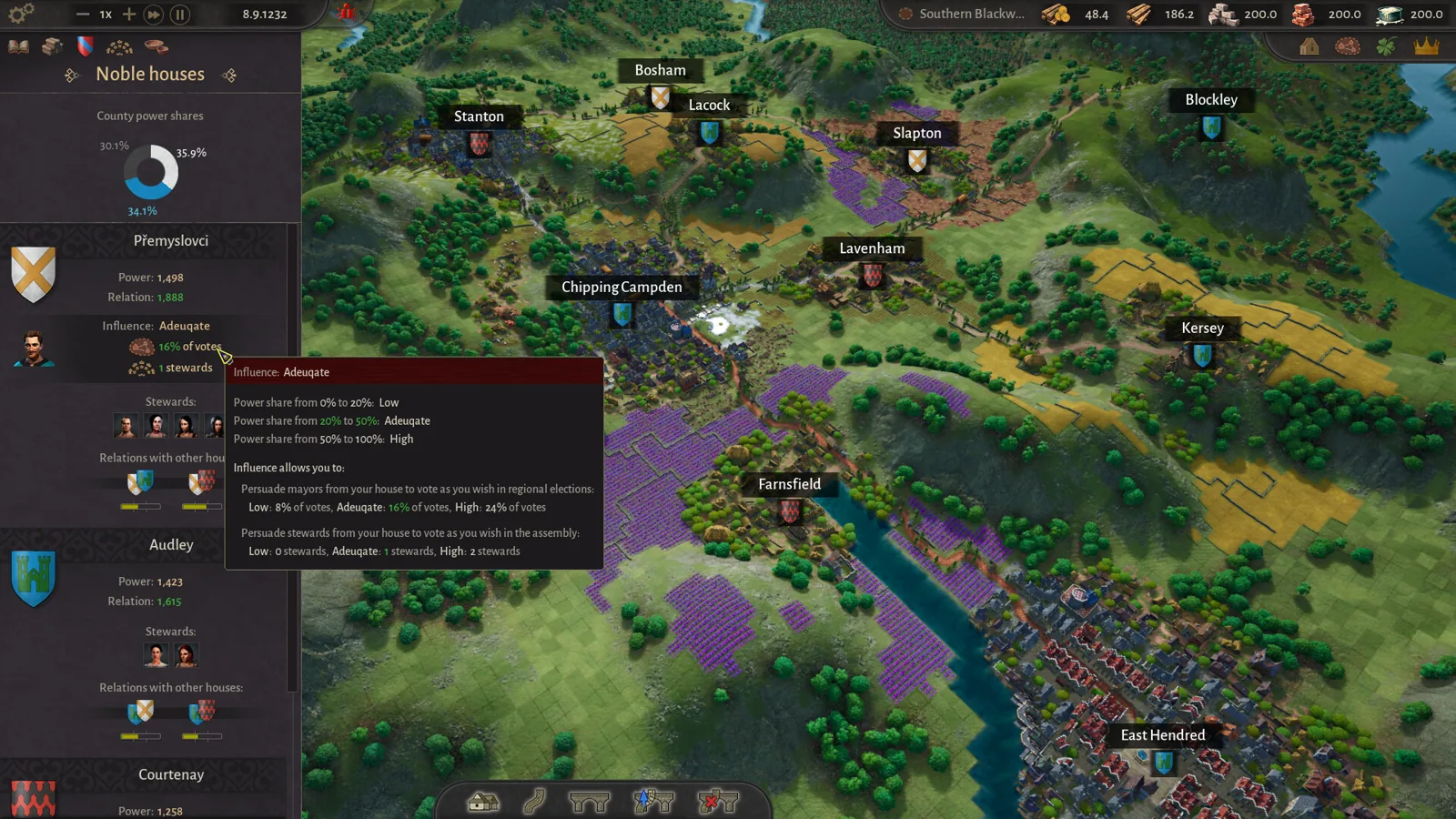
Look at which house proposed each privilege and which stewards are likely to support it. Community reports say house influence, relations and the proposal itself all affect votes.
Verify recipient eligibility
Confirm that your target region’s steward supports, or is likely to support, the proposal you want. If that steward backs another option, the region cannot receive your preferred privilege.
Convene or wait
Use Convene assembly while a gathering is available when the political alignment suits your plan. Waiting can be safer when a hostile or harmful proposal is currently ahead.
Grant the winning privilege
After the vote, choose one eligible region and assign the winning modifier. Patch notes mention removing a privilege, but they do not give a complete reversal procedure, so treat the choice as consequential.
Reported regional privileges
Community demo reports have documented the following modifiers. They are examples rather than a confirmed complete list, and the developer has not published official values for all of them.
| Privilege | Reported effect | Best regional fit |
|---|---|---|
| Right of Local Excise | −10% consumption for products made in that region | A region that consumes much of its own output |
| Right of Mayoral Ordinance | +15% mayor production bonuses | A region with capable, well-matched mayors |
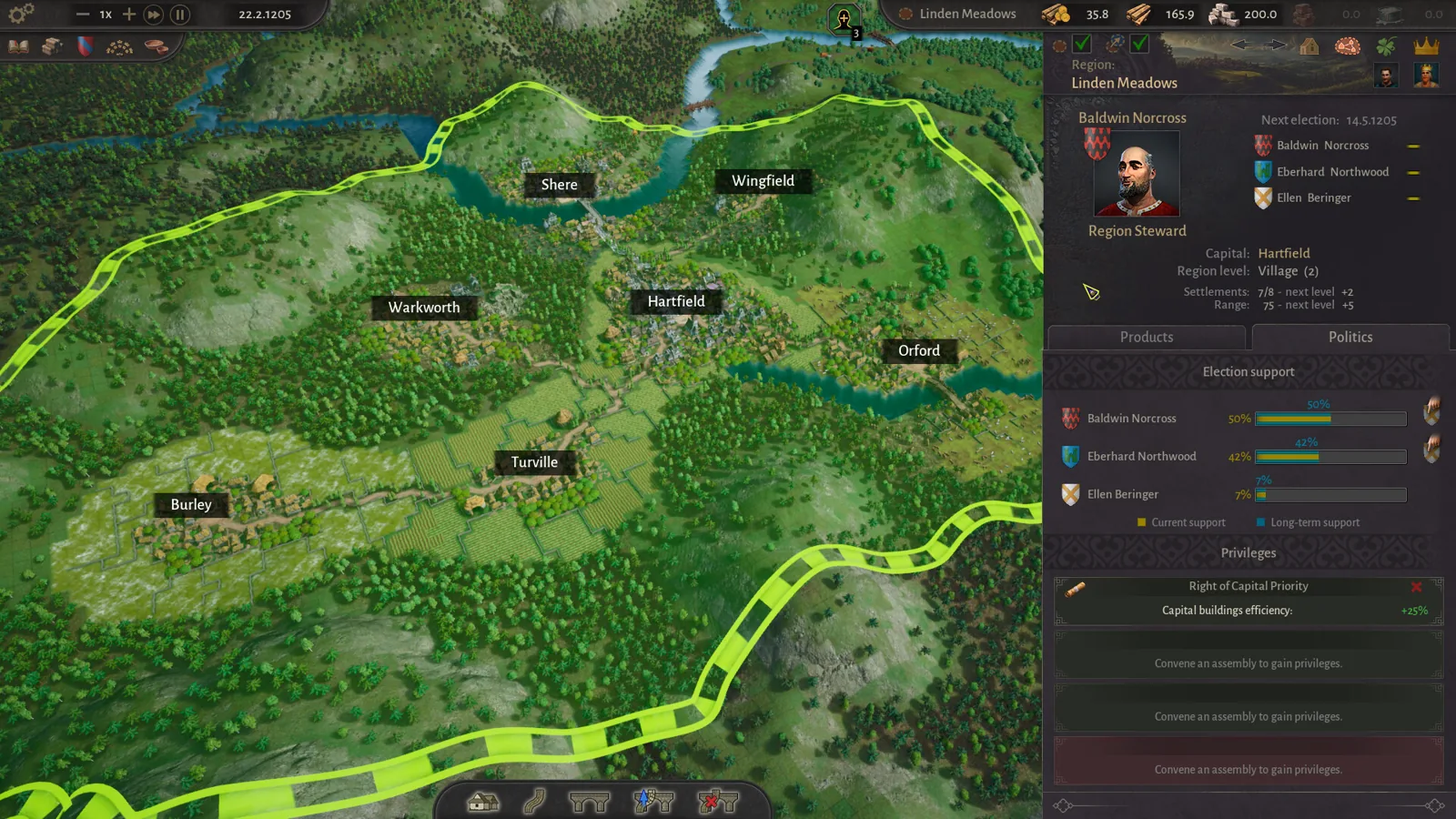
| Right of Capital Priority | +25% efficiency for capital buildings | A developed capital with valuable production |
| Right of Private Due | −10% building efficiency; repeated awards add another penalty | Corruption risk rather than a desirable reward |
The developer’s October demo announcement also names “additional traders” as a possible privilege, but that announcement does not state a number or privilege name. Treat the three economic levers shown in the table—consumption, mayor output and building efficiency—as the clearest reported examples.
Match the modifier to the region rather than automatically choosing the largest percentage. Right of Capital Priority has little value in an underdeveloped capital, while Right of Mayoral Ordinance depends on having mayors whose bonuses already suit the local buildings.
Corruption and forced assemblies
Community demo reports identify two ways politics can remove your timing advantage. A corruption proposal may build enough support to pass automatically, with the game warning that it is leading the Assembly. Separately, a house controlling more power than the other two houses combined can reportedly call an Assembly on its own chosen date.
The official Update 0.1.10 changelog fixed the corruption privilege’s value calculation when combined with mayor traits and fixed a crash associated with removing a privilege. That confirms corruption privileges are an active mechanic in the demo build, although the patch does not disclose the underlying formula.
| Warning sign | Risk | Practical response |
|---|---|---|
| One house approaches half of total power | It may soon outweigh both rivals together | Rebalance appointments and prop up rival houses before it dominates |
| A corruption proposal leads | It can reportedly pass without your chosen timing | Open the Assembly, rally backing for a rival option, or accept the damage |
| Your target steward opposes the likely winner | The intended region will be ineligible | Work toward a different steward or back a proposal that steward supports |
| A stacking negative privilege has passed | Repeated penalties can undermine production | Offset it with efficiency, mayor or culture bonuses where possible |
A county where no single house dominates is far easier to steer. Keeping every house below the reported dominance threshold also reduces the chance that an unfavorable privilege is forced through before you can respond.
Assembly strategy
- Choose the recipient region before deciding which proposal to support.
- Use Right of Local Excise where locally made goods are heavily consumed.
- Use Right of Mayoral Ordinance where mayor traits already match local production.
- Use Right of Capital Priority where capital buildings are developed and productive.
- Check whether the target region’s steward supports the likely winner.
- Do not let one house gain more power than its two rivals combined.
- Treat repeated Right of Private Due awards as a cumulative economic problem.
Steward politics and economics are directly connected. The steward determines whether a region can receive a privilege, while the proposal determines what that privilege changes. Evaluating only the bonus percentage misses half of the system.
FAQ
How does the County of Fortune assembly pick the winning region?
It does not choose a “winning region” directly. The winning proposal is selected first; afterward, you choose one region whose steward supported that proposal.
Can regional privileges stack?
Community demo reports say Right of Private Due may be awarded repeatedly, with each award adding to its building-efficiency penalty. Favorable privileges can reportedly layer on top of other boosts such as mayor traits, culture bonuses and capital effects, but the exact formulas are not officially documented.
Why did an Assembly pass without me?
Community reports say a house with more power than the other two houses combined can force an Assembly on a date of its choosing. A leading corruption proposal may also pass automatically if its support holds.
How often can the Assembly meet?
Community demo reports show a number of available assemblies and a Convene assembly control, but no fixed public recharge interval has been announced. A dominant house can reportedly create an additional forced gathering.
Checked on 2026-11-02 against the official County of Fortune Steam page and the developer’s Steam community announcements. Named privilege values, the forced-assembly threshold, stacking behavior and detailed panel labels remain community-reported rather than fully documented by Nepos Games.
Related guides for this game
County of Fortune Guides
County of Fortune Alburn iron mine and Foundry Guide
Build a County of Fortune Alburn iron mine, link roads, appoint a mayor, and ship ore into a level 2 foundry to smelt metal bars for downstream workshops.
County of Fortune chestnut oil mayor and chain guide
County of Fortune chestnut oil mayor picks and the chain: grow chestnuts, press oil in a level 3 town, then serve beef on chestnut oil to your Artisans.
County of Fortune Population and Culture Bonus Guide
How County of Fortune population shares scale culture bonuses, with the 75% threshold, Traditional Product slots, and settlement level limits explained.
County of Fortune Trade Routes: Land and River Setup Guide
County of Fortune trade routes explained: level up settlements, build markets and raft ports, connect roads and rivers, and move goods between regions.
County of Fortune Release Details

County of Fortune roadmap: Early Access timing and price
County of Fortune roadmap answers when Early Access starts, how long it may run, when full release could land, and if the price may rise after 1.0 launch.
County of Fortune Gameplay & Media
County of Fortune gameplay: County Building Loop Guide
See how County of Fortune gameplay works: found settlements on resources, assign mayors, connect by road, set recipes, level up, and unlock new regions.