
County of Fortune Corruption Proposal: How to Counter It
Quick answer
A corruption proposal in County of Fortune is a negative privilege backed by a noble house that can pass automatically in the Assembly if its support holds — when it leads, the game shows a warning letting you check the Assembly or deal with it later. Your three counters are to open the Assembly panel and rally support for an alternative, keep any single house from holding more power than the other two combined, and offset an already-passed penalty with efficiency, mayor or culture bonuses.
| Corruption proposal behavior | A house-backed privilege that can pass automatically in an Assembly if support holds; the game warns it is leading |
|---|---|
| Corruption privilege effect | Right of Private Due: buildings efficiency −10%, can be granted multiple times and stacks |
| Assembly basics (official) | Each noble house proposes a regional privilege, stewards vote, and the player picks which region among supporters receives the winnerCounty of Fortune on Steam |
| Corruption balancing patched | Demo update 0.1.10 (2026-10-20) fixed corruption privilege effect computation when combined with mayor traitsCounty of Fortune Steam Community |
County of Fortune corruption proposal: how it passes automatically in the Assembly, what counters exist, and how to offset a penalty if it already passed.

Table of Contents
A corruption proposal in County of Fortune is a negative privilege backed by a noble house that can pass automatically in the Assembly if its support holds — when it leads, the game shows a warning letting you check the Assembly or deal with it later. Your three counters are to open the Assembly panel and rally support for an alternative, keep any single house from holding more power than the other two combined, and offset an already-passed penalty with efficiency, mayor or culture bonuses.
Everything below reflects the demo build described in Nepos Games' official Steam announcements, plus demo-era notes from the County of Fortune Wiki. Early Access began on November 5, 2026, so exact numbers may shift during Early Access.
How the Assembly works
The Assembly is the political layer of the game. In the developer's demo announcement, Nepos Games describe the flow: stewards from all regions gather, every noble house puts one regional privilege forward, and each steward votes for a single proposal. The player then decides which region among the supporters receives the winning privilege.
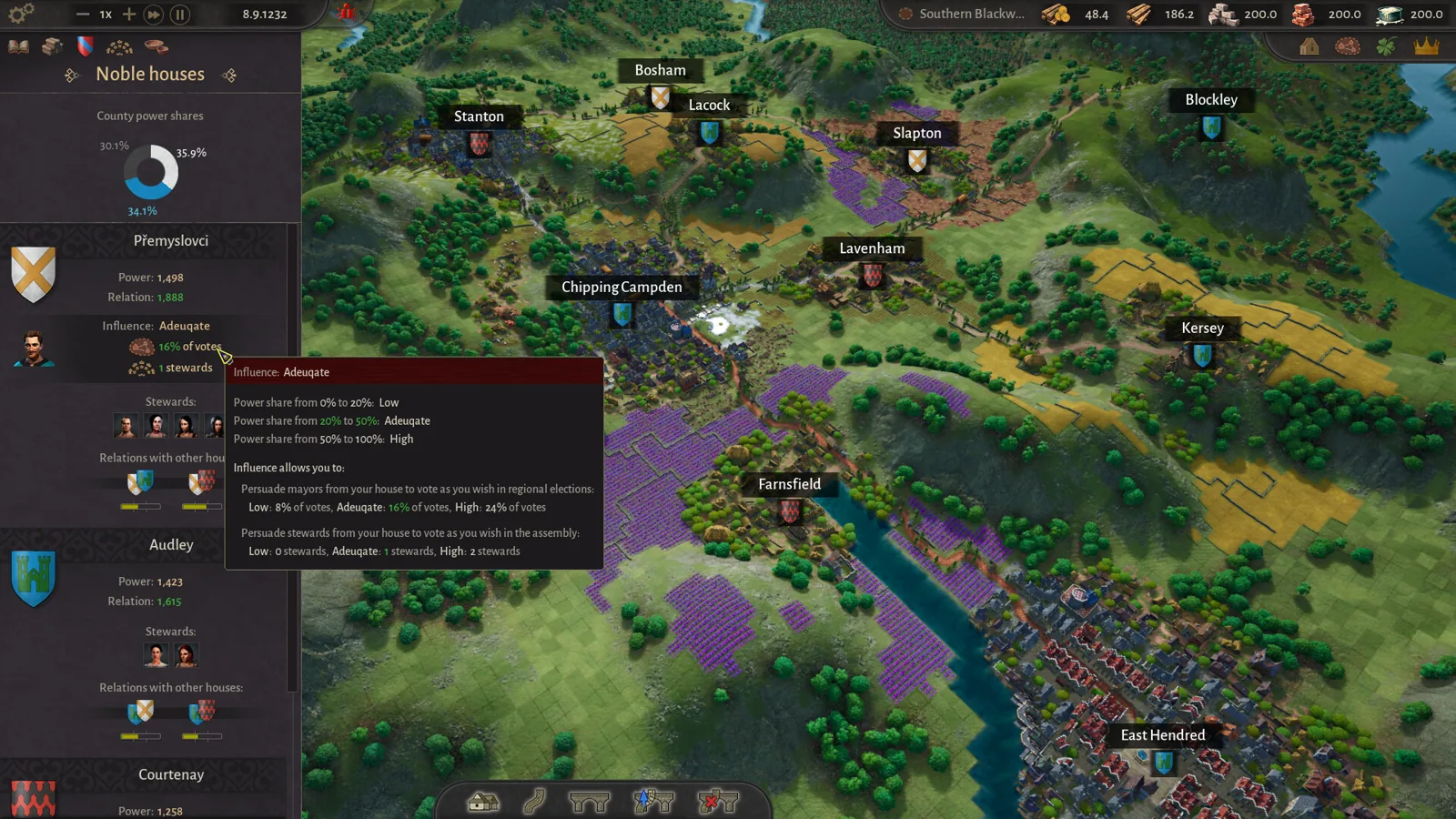
In the panel itself you can review which assemblies are open, read every proposal on the table with its modifier, and see which voters stand behind each one. You can convene an assembly yourself when one is available via the "Convene assembly" button, or an assembly can convene without you — that is where corruption becomes dangerous.

What a corruption proposal does
A corruption proposal is a house-backed privilege that can gather support and, if enough stewards back it, summon an automatic Assembly where it goes through. The demo surfaces this as a warning that a house's corruption proposal sits in first place, giving you the choice of inspecting the Assembly now or putting it off. Passing it can hurt the county.
Per the County of Fortune Wiki's Assembly page, the demo's corruption privilege is Right of Private Due, which reduces buildings efficiency by −10% and may be granted repeatedly, with each grant stacking. That stacking is what makes it dangerous: repeated efficiency hits across a county can, as the wiki's writers put it, quietly cancel out a mayor bonus.
Warning signs to watch
Four signals are worth checking before an assembly convenes, as compiled by players on the County of Fortune Wiki:
| Signal | What it tells you | What to do |
|---|---|---|
| One house nears half the county's power | It is about to outmuscle both rivals put together | Redistribute appointments or prop up the weaker houses |
| A corruption privilege sits in first place | An automatic pass is possible | Open the Assembly, push a rival proposal, or accept the damage |
| Your chosen region's steward backs a different house | That region is shut out of the winning privilege | Replace the steward or aim for another privilege |
| A harmful privilege is already in effect | Further grants may pile on | Compensate via efficiency, mayor or culture bonuses |

Countering a corruption proposal, step by step
React to the warning immediately
When the game warns that a corruption proposal is in first place, open the Assembly panel rather than choosing "deal with it later". The panel shows each proposal's effect and which stewards back it, so you can see how close it is to passing.Check house power shares
A house that outguns its two rivals combined can call an Assembly whenever it likes — meaning the proposal may sail through before you get a say. If a house is near that threshold, rebalance mayor appointments or strengthen its rivals before the forced vote happens.Build support for an alternative
Stewards decide where their support goes based on house influence, relations and the proposal itself. Back a positive proposal that can realistically win, and remember the recipient rule: only a region whose steward voted for the winning proposal can be granted it. Aim for a recipient region whose steward is already aligned, not one that opposes the winning house.Accept or offset the cost if it passes
If a corruption privilege passes anyway, each further grant adds another −10% to building efficiency. The County of Fortune Wiki's players suggest compensating with efficiency, mayor or culture bonuses — for example, stacking positive privileges such as Right of Capital Priority (+25% capital buildings efficiency) or Right of Mayoral Ordinance (+15% mayor production bonuses) in affected regions.Save before uncertain assemblies
If an Assembly's outcome looks uncertain, save first. That way you can weigh the possible outcomes before the county is locked into a stacked penalty.
Keeping corruption from ever leading
The long-term counter is political balance. Per the County of Fortune Wiki's player notes, a county where no single house can dominate is easier to steer than one where a house can force votes. Each house tends to back privileges aligned with its own interests, so:
- Track house power shares; intervene before one can outvote both rivals combined.
- Coordinate with steward elections — the steward you elect determines which regions are eligible for privileges in the next Assembly.
- Use positive privileges proactively on your strongest regions, so a corruption proposal has less room to become the best option on the table.
- Match privileges to region roles: reduced consumption for high-consumption regions, mayor bonuses where mayors are strong, capital efficiency in a developed capital — and avoid or offset corruption privileges wherever they can stack.
Note that the Assembly feature was added in the October 15, 2026 demo update, and the developer said a detailed follow-up post would come later. Exact values, the full privilege list and how corruption interacts with mayor traits may change through Early Access, so treat wiki-cited numbers as player estimates.
Next steps
- Learn how mayors and their production bonuses work — mayor bonuses are one of the main tools for offsetting a passed corruption penalty, and mayor rebalancing in the demo removed negative mayor bonuses.
- Review how settlements level up — a stronger economy makes it easier to absorb or offset a −10% efficiency hit while you rebuild political balance.
FAQ
What is a County of Fortune corruption proposal?
It is a privilege backed by a noble house that can pass automatically in an Assembly if its support holds. The game warns you when a corruption proposal is in first place, and passing it can harm the county — the known example, Right of Private Due, cuts building efficiency by 10% and stacks when granted repeatedly.
Can corruption privileges stack?
Yes. According to the County of Fortune Wiki's Assembly page, Right of Private Due explicitly allows repeated grants and its effects stack, which is why a repeated penalty can quietly wipe out a mayor bonus across the county.
Why did an Assembly pass a proposal without me?
A house whose power exceeds both rivals put together can call an Assembly whenever it likes, and its proposal can go through before you get a chance to act. Watch power shares and rebalance appointments to prevent this.
How do I stop a corruption proposal once the warning appears?
Open the Assembly panel, check which stewards back it, and build support for an alternative proposal — ideally one that can also be granted to a region whose steward voted for it. If you cannot swing the vote, save first and decide whether to accept the cost or offset it with bonuses.
Check note: Assembly mechanics and the corruption warning are confirmed by Nepos Games' demo announcement and patch notes on the official Steam page and the Steam community hub. Privilege values, stacking behavior and strategy points come from the player-maintained County of Fortune Wiki and are unconfirmed by the developer; exact numbers may change during Early Access (checked 2026-11-02).
Related guides for this game
County of Fortune Guides

County of Fortune How Do Mayors Work: Bonuses & Swaps
County of Fortune how do mayors work: learn mayor production bonuses, traits, house politics, and how to hire, swap or educate mayors without penalty.
County of Fortune How to Level Up a Settlement Guide
County of Fortune how to level up a settlement: meet every Food and Equipment need, click Level up in the settlement panel, and know the demo's cap.

County of Fortune how to level up region settlements
County of Fortune how to level up region: grow settlements, meet food and equipment needs, press Level Up next to the mayor portrait; demo caps region level.
County of Fortune How to Trade: Trade Routes Guide
County of Fortune how to trade: learn how to trade between regions by getting level 2 settlements, placing a small market or raft port, and linking roads.
County of Fortune Mechanics
County of Fortune Multiplayer: Is Co-op Available?
County of Fortune multiplayer status confirmed: the Steam page lists only single-player, so here is exactly what that means for co-op and shared counties.
County of Fortune Platforms
County of Fortune mac support: Steam platforms listed
County of Fortune mac support is not listed on Steam as of 2026-11-02: the page shows Windows and SteamOS + Linux only, with no macOS install announced.